



6 days Bhutan tour cost:
The 6 days Bhutan tour cost is given below and is inclusive of sustainable development fee (SDF) of US $ 100 per person per night and Bhutan visa fee US $ 40 per person.
Entrance fees for monuments and festivals visits to be paid separately.
- Solo travel: US $ 1775 per person.
- 2 Persons: US $ 1390 per person.
- 3 Persons or more: US $ 1365 per person.
Nature of trip: Private and guided trip to Bhutan.
Overview
The 6 days Bhutan tour itinerary will let you explore across three main districts of western Bhutan. These includes sightseeing and visit to major sites like the Tiger’s nest monastery in Paro, one of the most beautiful places to visit in Bhutan. In Thimphu, visit to the tallest statue of Buddha in the world. The route passes through beautiful Dochula pass (3140 m) on the way to Punakha. While in Punakha, visit to the magnificent Punakha dzong and hike to the imperial Khamsum Yulley monastery and many more.
Highlights
- Paro (2 Nights)
- Tiger's Nest Monastery (Taktsang Goemba, Paro Taktshang), Kyichu Lhakhang, Tamchog Lhakhang Iron Bridge, Paro Airport Birds Eye View Point, Bhutan National Dress Experience
- Thimphu (2 Night)
- Buddha Dordenma Statue, National Memorial Chorten, Tashichho Dzong (Thimphu Dzong ), Motithang Takin Preserve
- Punakha (1 Night)
Itinerary
Upon arrival at Paro International Airport, you will be met by your guide and transferred to your hotel in Thimphu, Bhutan’s beautifully located capital city which is about 45 minutes drive (53km) from the airport.
Lunch will be served at your hotel.
In the afternoon visit the Tashichho Dzong, the beautiful medieval fortress/monastery which houses most of the Government’s office and King’s Throne room. It is also the summer residence of Je Khenpo, the Chief Abbot. Then visit the National Library which has a vast collection of ancient Buddhist texts and manuscripts. After that, drive to Painting School, famous for traditional thangkha paintings. Here you will see students at work producing intricate design on cloth. If time permits, also visit the Traditional Medicine Institute.
Dinner and overnight at your hotel.in Thimphu
Breakfast at your hotel.
Travel to Punakha with a stopover at the Dochula pass (altitude 3140m). If the weather is clear, you will have spectacular views across the Himalayas.
Here you can also take a 3 hour trek to Lhuenchutse monastery several hundred meters above the Dochula pass. A late lunch or afternoon tea will be served at the Dochula Resort.
On the way to Punakha, visit Chimey Lhakhang located on a hillock in the centre of the valley below Metsina. Built in 1499 the temple is also known as “the Temple of Fertility”. A wooden effigy of the lama’s thunderbolt is preserved in the lhakhang, and childless women go to the temple to receive a blessing.
Dinner and overnight at your hotel in Punakha.
Breakfast at your hotel.
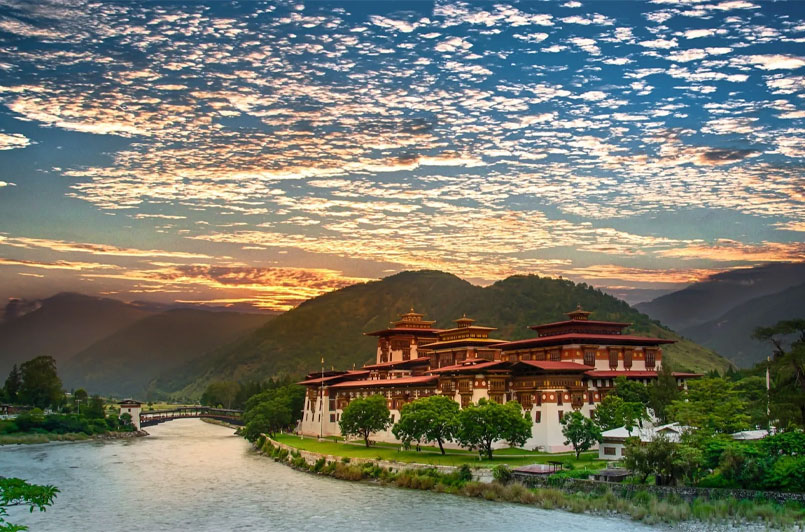
Take a 45 minute walk to a chorten or stupa at Nyizergang followed by a visit to the amazing Punakha Dzong which was built in 1637. This impressive dzong is situated between Pho Chu (Male River) and Mo Chu (Female River). The Punakha Dzong was the second of Bhutan’s dzongs and until the mid-1950s, it served as the seat of the government. It is also the winter residence of Je-Khenpo and the Central Monastic Body.
After lunch in Punakha, drive to Wangdue Phodrang and visit the Wangdiphodrang Dzong built in 1638. Legend relates that as the people were searching for the site of the Dzong, four ravens were seen flying away in four directions. This was considered an auspicious sign, representing the spread of religion to the four points of the compass. The dzong is situated at the confluence of Mo Chu and Tsang Chu rivers.
Later in the afternoon drive to Thimphu.
Dinner and overnight at your hotel in Thimphu.
After breakfast, drive through to Paro to visit Simtokha Dzong, built in 1627 and also to visit the ruins of Drukgyel Dzong which was built in 1644 to commemorate the victory over the Tibetan invaders. The Dzong was used as an administrative center until 1951 when a fire caused by butter lamp destroyed it. Then visit Kyichu Lhakhang, one of Bhutan’s oldest and most sacred monasteries dating from the introduction of Buddhism in the 8thcentury and also visit the Rimpung Dzong built in 1646.
Dinner and overnight at your hotel in Paro.
After breakfast, take a short drive to the base of the famous Taktshang Monastery or Tiger’s Nest, which clings to a sheer rock face at a height of 2600m above sea level. The climb is quite steep, but ponies are available for those who feel they cannot make the climb themselves.
The main temple was built around Guru Rimpoche’s meditation cave in 1684. This incredible monastery clings to the edge of a sheer rock face which plunges 900 meters into the valley below. Legend has it that Guru Padmasambhava, the tantric mystic who brought Buddhism to Bhutan in 747 AD, flew here on the back of a flying tiger, Dorje Drolo.
After lunch, visit Ta Dzong an ancient watchtower, which now houses the National Museum. Below the museum is the Rinpung Dzong (literally meaning “Heap of Jewels”), the centre of civil and religious authority in this valley, built in 1646.
Dinner and overnight at your hotel in Paro.
After breakfast drive to Paro International Airport for your departure from Bhutan.
Cost
The Cost Includes
- All meals [breakfast / lunch / dinner and evening tea].
- Accommodation [twin / double sharing basis]. Single room supplement is extra.
- All transportation within the country including airport transfers.
- Sustainable development fee.
- Bhutan visa fee.
- English speaking local guide.
- Sightseeing.
- Bottled water during the tour.
The Cost Excludes
- Drukair / Bhutan Airlines fares.
- Entrance fees for museums / monuments and festival visits.
- Insurance premiums.
- Payments for service provided on a personal basis.
- Cost for any services not mentioned in the “Cost Include head”.
- Cost incurred due to mishaps, strikes, political unrest etc.
- Personal expenses such as laundry, beverages, tips or any other personal services.
FAQs
Yes, if you are traveling with a group of friends or with your family, you can customize your own Bhutan group tour. Please contact your professional travel consultant to discuss and arrange a customized group tour that meets your needs and preferences.
Climate: The ideal seasons for travel in Bhutan are from March to November when the weather is most suitable.
Off-peak season: From December to February, it is winter and considered the off-peak travel period. During the day, temperatures hover around 15 degrees Celsius, dropping below freezing at night. From June to September, it is summer and the rainy season, with temperatures around 23 degrees Celsius during the day and 15 degrees Celsius at night.
Peak season: The peak travel periods are from March to May and September to November.
In the Paro region of Bhutan, staple foods include rice, buckwheat, corn, and red rice. Chili and dairy products are commonly used as accompaniments. One of the most famous traditional dishes is Emma Datshi, which consists of chili with cheese. While beef, lamb, and pork are popular meats, it’s important to note that Bhutan follows Buddhist principles of non-violence and does not slaughter animals within the country. Most of the meat available in the market is imported from neighboring India and primarily caters to tourists. Beverage options include black tea, butter tea, rice wine, and beer.
Yes, you can charge batteries en route. Charger should be brought. There are hot shower facilities as well. You may have to pay a certain amount for both ($1-$2). Negotiate. Also, a hot water facility could be free at a lower elevation.
Bhutan experiences long hours of sunlight, and the UV rays can be intense. It is recommended to bring your own sunscreen, hat, and wear long-sleeved clothing to protect yourself. Additionally, staying hydrated by drinking plenty of water and consuming fruits is essential.
Respect for Customs and Regulations: Please show respect for Bhutan’s religious customs, traditions, and adhere to the relevant government regulations during your visit.


